
Academia & Publishing
Using AI as a Tool
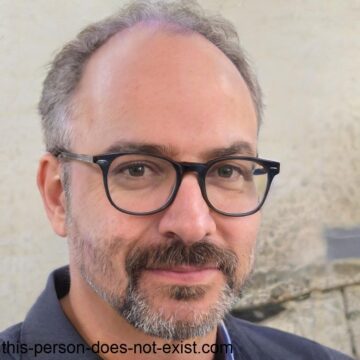
AI Generated Image, Source: thispersondoesnotexist.com
by Philip Harding, copyeditor
November 1, 2025
It might be easy to think of future publications as nothing more than spam, articles written by generative AI bots where the human barely lifts a finger other than to copy/paste. But that calculation couldn’t be further from the truth. In academia, AI is going to be both a great tool and a tremendous challenge. The challenge is happening as I (a mere human by the way) write these words (but it could be AI- that should be acknowledged). The challenge, actually, is the way in which we will integrate AI into the writing and editorial processes for optimal results. It’s not the creator that is of concern as much as it is the editor. My assumption, and I know those are dangerous, is that no matter how much AI sounds human, it will (probably) always be easy to spot. Consider AI-generated music and AI-generated art. Yes, sure, it easily fools you: initially. But there is always a crack in the bell, so to speak, where it just falls flat. An article written by AI on, say, The Greatest Scientific Minds of the 20th Century will be just that: Historically accurate and maybe even inspiring. But it’s a dull, predictable read nevertheless.
As an academic writer who writes in English but whose native tongue is not English, relying on AI may seem a tempting way to speed up your tasks and finish assigned articles, confident that the grammar will be solid and your paper will sound professional. But the truth is that relying on AI to write your papers for you adds nothing to your profession and, over time, will degrade your skills as a researcher and hinder your growth moving forward. No matter how bad you think your English is, it is far better to write on your own power as much as you can, and let a proofreader improve your paper for style and grammar.
At Planet, we are “AI agnostic,” that is, we don’t have a policy or opinion regarding our clients’ use of AI. We also use AI at times (I’m not now) to proofread and help us with awkward constructions. Some of us are continuing our higher education studies and use AI to generate and suggest ideas and concepts to further our research and polish our paper’s structure and organization. These are appropriate uses for AI that will save you time and improve the quality of your work. We have no say in whether you simply ask AI to write a paper for you and attempt to publish it, but we think it is obvious that such papers are going to be obvious to spot and not well-received. In fact, plagiarizing through AI is still plagiarism, and many teachers and professional organizations won’t take a chance on a work they think is AI. Regardless, we will work with clients who use AI- we would prefer they tell us up front, though, so that we may try to find their true voice!
What about translation, you may ask? Software (machine) translation has been popular for quite some time now (much longer than AI) and is widely used. The good news for academic writers is that, as long as English remains the global language for academia, you, the writer, will eventually have to grapple with journals written in English. You can translate those, in turn, but we, the editors, will have the bibliography and be able to compare your work to the originals. This is not a bad thing as it gives us a foundation for our work and can also show us any discrepancies between original intent and distortion through machine translation. The minus in machine translation is similar to that of AI (machine translation is a form of AI, after all): your prose comes out sounding robotic, and there are bound to be nonsensical elements in the semantics of the work. Language, even dry, academic language, uses a lot of idiomatic expressions that often do not translate well. But it is fairly easy for us to edit your translated paper to the point that it is in line with your voice and reads well, like a native speaker had written it.
As you can see, I’m not the greatest writer either; my blogs are rather clunky and are not going to win any awards. I wanted to see what ChatGPT thought of my blog project, and I received the following (compared with Chat, my blog was riddled with issues, but issues that only a human would make):
How might my clients interact with AI?
AI tools are reshaping the way scholars and editors approach academic writing. Programs such as ChatGPT, Grammarly, and QuillBot can now check grammar, reorganize paragraphs, and even suggest phrasing that sounds more natural in English. For international researchers, this technology can be liberating—but also confusing. What is ethical to use? When does assistance cross the line into authorship? At Planet Proofreading, I view AI as a “smart tool”, not a replacement. Used wisely, it helps authors express ideas more clearly while allowing editors to focus on nuance, logic, and precision—the very things machines still struggle to master.
Conclusion: Try a 300-word sample, on us!
Artificial intelligence will keep advancing, but clear, persuasive academic writing will always require a human touch. The best results come from collaboration—researchers using AI for early outlines for drafts, and editors refining those drafts into publishable manuscripts. At Planet Proofreading, I combine decades of ESL editing experience with responsible use of AI-assisted tools to improve accuracy and save time without losing authenticity. If you’re curious how that process feels in practice, send a 300-word sample for a free edit. Let’s see how human expertise and intelligent technology can work together to help your research shine.
Get Your Sample From Planet Today!
For first-time customers only, we provide free proofreading of up to 300 words for your evaluation. We will further answer any questions you may have regarding the proofreading and offer suggestions for further writing. All free of charge! After evaluating our work, you may decide whether you would like to use our services or not. Free proofreading and its associated services are free to any group or individual we serve. Consultations are always free no matter what stage of the proofreading we are in, and our number one goal is always in effect: nothing makes us happier than to hear the good news, “Paper Accepted!”
Do you want your articles to get published? Do you want to advance your career, and promote the field you’re in ?
Subscribe to our newsletter.
Recent Comments